 Back to Listing
ABOR approves Regents’ Grant to strengthen wildfire resilience in Arizona
Tri-university research effort focuses on developing practical tools and strategies for managing wildfire risk.
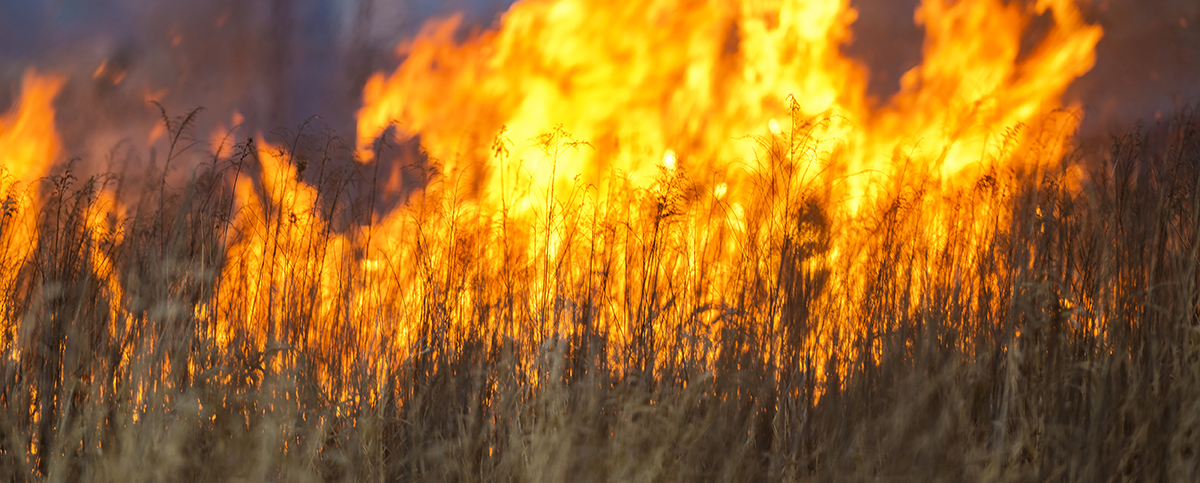
Grassland wildfires are burning faster, spreading farther, and threatening Arizona's desert landscapes more than ever before. Invasive, non-native plants like stinknet, red brome and buffelgrass are crowding out native species and dramatically increasing the amount of fuel available to fires, while shifting weather patterns are compounding the danger to nearby communities and iconic wildlife like the saguaro cactus.
To address these changing conditions and better protect Arizona’s natural landscapes, the Arizona Board of Regents has approved a new Regents’ Grant to fund a tri-university research effort focused on improving how we manage wildfire risk in the Sonoran Desert.
The project, conducted in partnership with the Arizona Department of Forestry and Fire Management, brings together researchers from Arizona State University, Northern Arizona University and the University of Arizona in a coordinated effort to develop and evaluate wildfire fuel treatments that will help land managers reduce fire risk. Fuel treatments in deserts are tricky and require different approaches than are used in forested systems. This project will identify which treatments are most effective and help to protect the state’s beautiful desert systems.
“This investment reflects the board’s commitment to using our public universities’ expertise to protect Arizona’s land and strengthen our ability to fight wildfires,” said ABOR Chair Doug Goodyear. “We've seen how costly and devastating these fires can be. This research will support the people on the front lines and help safeguard communities that are exposed to fires all across Arizona."
The project focuses on what, when and where land managers need to act before a fire starts, including which treatments are most effective, when fire danger increases and where limited resources can have the greatest impact. Researchers will evaluate treatments already in use across Arizona landscapes, test additional approaches with land management partners and analyze climate and fuel patterns to identify where risk is growing. This includes identifying areas where non-native grasses and other invasive species are increasing fire potential.
“Arizona is facing a fundamental shift in wildfire risk across the Sonoran Desert as invasive vegetation continues to alter landscapes that historically experienced very little fire,” said Thomas Torres, director of the Arizona Department of Forestry and Fire Management. “Land and fire managers are making critical decisions every day about where to invest limited resources to reduce wildfire risk, protect communities and preserve some of Arizona’s most iconic natural landscapes. This research will help provide the science, data, and decision-support tools needed to inform decisions and maximize the return on every taxpayer dollar invested in wildfire mitigation and firefighting efforts. By partnering with Arizona’s public universities, we are combining world-class research with real-world operational needs to develop practical solutions that will strengthen Arizona’s resilience to wildfire.”
The team will also develop decision-support tools that can be used by fire officials, state agencies and land managers. These include a treatment menu that compares options by effectiveness, uncertainty, cost and feasibility, climate-fuel scenarios and mapping tools that help identify where action is most needed. Researchers also plan to establish the Sonoran Fire Management and Resilience Network, a shared research network that will test fuel reduction treatments across multiple locations using the same standard approaches. This will enable land managers to compare results and techniques across different treatment approaches, site conditions and jurisdictions based on sound science.
“This project reflects what fire officials, land managers and agency partners identified as the most pressing needs in the field,” said Andi Thode, Ph.D., principal investigator and professor of fire ecology and fire management at the NAU School of Forestry. “They pointed to gaps in the information available to assess risk and target treatments. Our research is focused on closing those gaps with data and guidance that can strengthen on-the-ground decision making.”
This effort builds on the board’s Future of Arizona wildfire convening held last year at the U of A’s Biosphere 2 in Oracle. The convening brought together the board, the state’s public universities and the Arizona Department of Forestry and Fire Management with state, federal, tribal, fire and industry leaders to shape a strategic roadmap for Arizona’s wildfire strategy and long-term resilience. The gathering was an opportunity to discuss real-world challenges, identify near-term research needs and advance those ideas into action through the Regents’ Grant program.
Funded through the Technology and Research Initiative Fund (TRIF), Regents’ Grants bring together Arizona’s public university researchers, state government agencies and city and counties to tackle pressing challenges of greatest need and interest to Arizonans. You can learn more about the Regents’ Grants program and other projects funded by the board here.
Research contributors from Arizona’s public universities include:
- Andi Thode, Ph.D., principal investigator (NAU)
- Anita Antoninka, Ph. D. (NAU)
- Clare Aslan, Ph.D. (NAU)
- Matt Bowker, Ph.D., M.S. (NAU)
- Kitty Gehring, Ph.D. (NAU)
- Georgia Roberts (NAU)
- Helen Rowe, Ph.D, M.S. (NAU)
- Sara Souther, Ph.D. (NAU)
- Mike Crimmins, Ph.D. (U of A)
- Elise Gornish, Ph.D., M.S. (U of A)
- Christina Greene, Ph.D., M.A. (U of A)
- Aaron Lien, Ph.D., M.S. (U of A)
- Matt Meko, M.S. (U of A)
- Rachel Mitchell, Ph.D. (U of A)
- Fábio Albuquerque, Ph.D., M.S. (ASU)